
When businesses in Singapore need fast funding, SMEs often struggle if they have little banking history. That is why understanding business loan requirements is important.
A Licensed Moneylender in Singapore can be a practical option. They do not focus much on long credit history or heavy collateral. Instead, they look at how the business is doing now.

Still, approval follows clear rules under the Singapore Moneylenders Act.
This guide explains the key business loan requirements. It covers who can apply, what documents are needed, and what affects approval. It also shows how lenders like Cash Mart review applications in 2026.
Table of Contents
Understanding Business Loans from Licensed Moneylenders
A business loan from a licensed moneylender is a short- to mid-term financing option designed to support cash flow, expansion, inventory purchase, or operational expenses. Understanding business loan requirements is important before applying, as it helps businesses prepare the right documents and improve approval chances.
Unlike banks, a Licensed Moneylender in Singapore typically evaluates applications based on real-time financial health rather than long credit history or audited financial statements. This makes them especially relevant for startups, SMEs, and cash-flow-driven businesses.
For example, lenders may assess:
- Recent bank transactions
- Monthly revenue flow
- Business registration status
- Director’s financial standing
This approach allows faster approval and greater accessibility for businesses that might otherwise be rejected by banks.
Basic Eligibility Requirements for Business Loans
To qualify for a business loan from a licensed moneylender in Singapore, businesses must meet several core business loan requirements. These requirements are regulated and consistent across most lenders.
1. Registered Business Entity
Your business must be legally registered in Singapore:
- Private Limited Company (Pte Ltd)
- Sole proprietorship
- Partnership
A valid ACRA registration is required.
2. Active Business Operations
Lenders usually need proof that the business is active. This may include:
- Recent invoices or contracts
- Business bank account transactions
- Proof of ongoing sales or services
A Licensed Moneylender in Singapore often prefers businesses with steady cash flow, even if they are new.

3. Minimum Age and Residency of Directors
Directors or business owners must usually:
- Be at least 21 years old
- Be Singapore Citizens, Permanent Residents, or valid work pass holders
4. No Undischarged Bankruptcy
Businesses or directors under undischarged bankruptcy are not eligible.
5. Ability to Repay
Unlike banks that rely on credit scores, moneylenders assess repayment ability using key business loan requirements such as:
- Monthly revenue
- Existing debts
- Cash flow stability
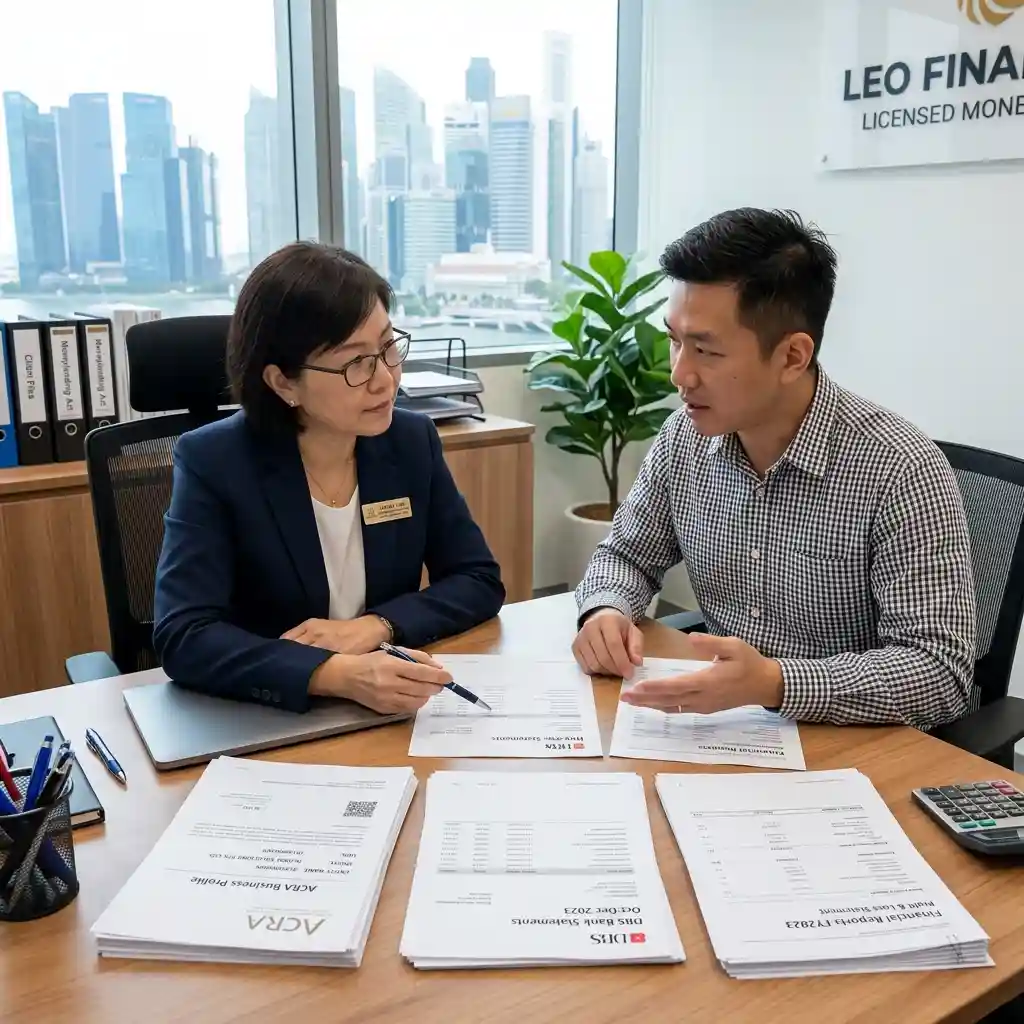
Required Documents for Business Loan Applications
Documentation is a key part of business loan requirements. A Licensed Moneylender in Singapore will usually ask for the following:
Business Registration Documents
- Latest ACRA business profile
- Company constitution (if needed)
Financial Documents
- Corporate bank statements (usually 3–6 months)
- Profit and loss statements (if available)
- Balance sheet (for older companies)
Identity Documents
- NRIC or passport of directors or partners
- Work pass (if applicable)
Operational Proof
- Tenancy agreement for business premises
- Business contracts or invoices
- Company stamp or seal (if required by the lender)
These business loan requirements help the lender check if your business is stable. They also help assess risk and repayment ability.
Key Factors That Affect Loan Approval
Even if you meet basic business loan requirements, approval depends on how strong your application looks in real life. Licensed moneylenders review several simple, performance-based factors.
1. Business Cash Flow Consistency
Stable monthly revenue is one of the strongest approval signs. Lenders prefer businesses with steady income instead of irregular spikes.
2. Debt-to-Income Position
Existing loans or financial obligations can affect how much you can borrow. Even if approved, loan amounts may change based on repayment ability and overall business loan requirements.
3. Industry Type
Some industries carry higher risk because income can change often. Essential service businesses are usually seen in a more positive light.
4. Director Financial Profile
A Licensed Moneylender in Singapore may also check the personal financial standing of company directors, especially for SMEs. This helps confirm if the business can meet business loan requirements and repay on time.
Loan Limits and Borrowing Capacity
Business loan limits are not fixed like personal loans. Instead, they are influenced by income, repayment ability, and lender risk assessment.
For unsecured lending:
- Higher-income businesses may qualify for larger facilities
- Smaller SMEs may receive conservative initial loan amounts
- Secured loans may allow higher borrowing amounts depending on collateral
Unlike banks, licensed moneylenders often provide more flexible access to capital, especially for short-term working capital needs.
Why SMEs Choose Licensed Moneylenders Over Banks
Many SMEs struggle with bank financing because of strict business loan requirements, such as:
- 2–3 years of audited financial statements
- Strong credit history requirements
- Longer processing times
In contrast, a Licensed Moneylender in Singapore typically offers more flexible business loan requirements and:
- Faster approval (sometimes within 24 hours)
- Less focus on long financial history
- More flexible documentation requirements
- Short-term working capital solutions
This is especially useful for businesses facing urgent cash flow gaps or seasonal demand changes.
Example: How Licensed Moneylenders Assess Applications
Instead of focusing on long-term credit history, lenders often evaluate:
- Recent 3–6 months of bank activity
- Current monthly revenue trends
- Business sustainability indicators
- Director’s financial behavior
For instance, a small SME with steady monthly inflows but only 1–2 years of operation may still qualify, even if banks reject the application due to insufficient audited records.
How to Improve Your Approval Chances for Business Loans
Even if you meet basic business loan requirements, you can still take simple steps to improve your chances of approval with a Licensed Moneylender in Singapore. Small changes in how you prepare your application can make a big difference.
1. Keep Your Bank Records Clean and Clear
Lenders look closely at your recent bank statements. Make sure your income and expenses are easy to understand. Avoid mixing personal and business spending.
2. Show Steady Monthly Income
A stable cash flow is more important than high income. Regular deposits help prove that your business can meet business loan requirements and repay on time.
3. Reduce Existing Debt Before Applying
If possible, pay down small loans or credit lines first. Lower debt improves your repayment profile and increases approval chances.
4. Prepare Complete Documents Early
Missing papers can slow down your application. Gather all required business loan requirements like ACRA records, bank statements, and ID documents before applying.
5. Be Honest About Your Business Situation
Always provide true financial details. Licensed lenders value transparency and may still approve loans if your repayment ability is strong.
Working with Providers Like Cash Mart
Many SMEs explore options with established lenders such as Cash Mart, which operate within Singapore’s regulated lending framework and follow standard business loan requirements.
A provider like Cash Mart typically follows standard licensing rules and evaluates applications based on:
- Current financial performance
- Business stability
- Repayment ability
- Required documentation completeness
When working with any lender, including Cash Mart, businesses should always ensure they meet basic business loan requirements and:
- Check that the lender is listed under the Ministry of Law’s Registry
- Make sure all fees and interest rates are clearly shown
- Read and understand the loan agreement before signing
Choosing a legitimate Licensed Moneylender in Singapore helps ensure legal protection and clear, fair lending terms.
Common Mistakes to Avoid When Applying
Many applications get delayed or rejected due to avoidable issues:
1. Incomplete Documents
Missing bank statements or ACRA records can delay approval significantly.
2. Inconsistent Financial Records
Large gaps or unexplained transactions may raise concerns about cash flow stability.
3. Over-Borrowing Requests
Requesting loan amounts that exceed realistic repayment capacity reduces approval chances.
4. Not Comparing Lenders
Different moneylenders may offer different terms, even under regulated caps.
Conclusion
Understanding business loan requirements in Singapore is essential for SMEs seeking fast and flexible financing. Licensed moneylenders provide a regulated alternative to traditional bank loans, focusing more on real-time business performance than long credit histories.
To qualify, businesses must ensure they are properly registered, actively operating, and able to demonstrate consistent cash flow. Documentation such as ACRA records, bank statements, and identity verification are mandatory across all applications.
For SMEs that need quick access to capital, a Licensed Moneylender in Singapore can be a practical solution—especially when working with established providers like Cash Mart who operate within strict regulatory guidelines.
Ultimately, success in securing financing depends not just on eligibility, but on presenting a clear, stable, and credible financial picture to lenders.
FAQ: Business Loan Requirements in Singapore
1. What do I need to apply for a business loan?
You need an ACRA-registered business, proof of income, bank statements, and ID documents. Some lenders may also ask for invoices or contracts.
2. Can new businesses get a loan?
Yes. New businesses can apply if they show steady cash flow and can prove they can repay the loan.
3. What documents are usually required?
Common documents include:
- ACRA business profile
- 3–6 months bank statements
- NRIC or passport
- Proof of business activity
4. How fast is approval?
Approval can be fast, sometimes within 24 hours, if all documents are complete.
5. Do I need good credit?
Not always. Many lenders focus more on income and cash flow than credit scores.
6. Why do applications get rejected?
Common reasons include missing documents, weak cash flow, or too much existing debt.